Oral appliance therapy for obstructive sleep apnea
Oral appliance therapy uses a custom mandibular advancement device worn over your teeth while you sleep. Often called a “sleep apnea mouth guard” or “mouthpiece,” it may be an option if you have difficulty using CPAP or want to discuss another treatment with your care team.
At RespAir Sleep in Raleigh, Dr. Ashley DeSaix provides oral appliance care tailored to your teeth, jaw and treatment needs.
Request a consultation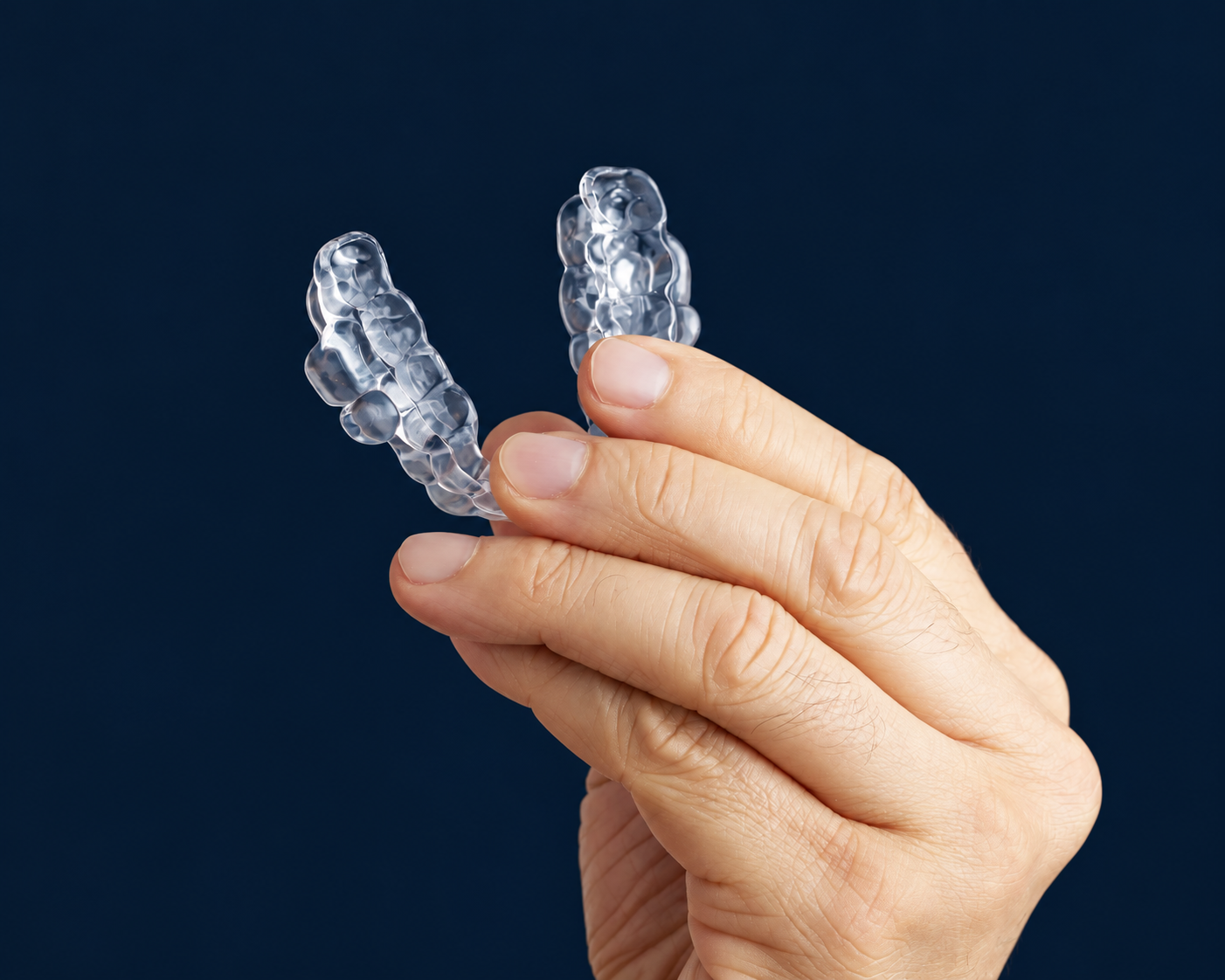
How does an oral appliance work?
A custom oral appliance, also called a mandibular advancement device (MAD), supports your lower jaw in a forward position. This can bring the tongue and connected tissues forward and help reduce collapse of the upper airway during sleep.
The right jaw position varies from person to person. Moving the jaw farther forward is not always better; adjustment balances your comfort with your breathing response.
Explore the principle
With an appliance: supporting the lower jaw forward can help reduce airway collapse during sleep.

Is a sleep apnea mouth guard the same thing as an oral appliance?
“Sleep apnea mouth guard” is a common name for a prescribed oral appliance, also called a mandibular advancement device (MAD). At RespAir, we provide a custom, adjustable device fitted to your teeth and jaw.
A sports mouthguard or grinding guard has a different purpose: it protects teeth and is not designed to treat sleep apnea. A non-custom, over-the-counter device is not the same as the prescribed appliance and ongoing care described here. [4]
Is oral appliance therapy right for you?
Your sleep study, health history, teeth, jaw, and treatment experience guide suitability. Treatment for obstructive sleep apnea requires a physician’s diagnosis and prescription, along with the dental evaluation we do here at RespAir Sleep.
An appliance may be considered for adults with mild to moderate obstructive sleep apnea, people who have difficulty tolerating or consistently using CPAP, or those who prefer another treatment. Your oxygen levels, dental health and treatment response also help determine which options are appropriate.
Severe sleep apnea needs particular care when considering an alternative to CPAP.
If snoring is your main concern and you have not had a diagnosis, start with an evaluation. Snoring alone cannot tell you whether you have sleep apnea. An appliance may be considered for primary snoring after a medical evaluation rules out obstructive sleep apnea.
How does an oral appliance compare with CPAP and other treatments?
These treatments work in different ways. CPAP generally reduces breathing events and improves oxygen levels more effectively than an oral appliance; the choice also depends on your diagnosis, treatment response and ability to use the treatment consistently. [4]
| Treatment | What it involves | RespAir’s role |
|---|---|---|
| CPAP | Pressurized air delivered through a mask during sleep. | Managed by your medical sleep team; we coordinate with your physician when discussing alternatives. |
| Custom oral appliance | A prescribed, adjustable device that supports the lower jaw forward. | Dental evaluation, appliance selection, fitting, adjustments and follow-up. |
| Combined therapy | An oral appliance used together with CPAP when recommended by your care team. | Appliance care in coordination with your medical provider. Learn about combined therapy. |
| Surgical or implant options | Procedures considered after medical evaluation of suitability. | Provided by other medical specialists. |
Compare the full range of sleep apnea treatment options, or explore what to discuss when CPAP is difficult.
What happens during treatment at RespAir?
Your evaluation and appliance selection
Dr. DeSaix reviews your sleep study, previous treatment and goals, and examines your teeth, gums, bite and jaw joints. We take a digital scan of your teeth and bite to plan your custom fit.
We work with several appliance designs and manufacturers. Selection takes into account your clinical needs, comfort, preferences and insurance requirements.
Fitting and adjustment
When your appliance is ready, we check its fit and show you how to put it in, remove it and care for it. We explain how adjustments will be managed and what to report as you get accustomed to wearing it.
We refine the jaw position through small adjustments, using your comfort, symptoms and measured breathing results. At RespAir, titration studies with cloud-connected monitoring devices help guide this process. The time needed to find an appropriate setting varies.
Checking treatment effectiveness
After adjustment, we refer you to your medical provider for formal follow-up sleep testing with the appliance. This checks how well it is treating your sleep apnea. Less snoring or feeling more rested does not, by itself, establish that your sleep apnea is controlled.
Keep using prescribed treatment as directed while your appliance is being fitted and evaluated. Ask your treating medical provider when and how to make any change to CPAP.
What is it like to use an oral appliance?
An oral appliance is compact, quiet and easy to bring when you travel. When used on its own, it needs no hose, motor or electrical connection. It works while you wear it; consistent nightly use is part of treatment.
We provide instructions for cleaning and storing your appliance and offer appliance cleaning at the practice. Continue your regular dental appointments, and tell us about new dental work or changes in how the appliance fits.
Follow-up visits allow us to check your teeth, bite, jaw comfort and appliance condition. Changes in symptoms or health may also call for additional testing or a change in treatment.
Can an oral appliance affect your teeth or jaw?
Possible side effects include jaw or tooth soreness, irritation, extra saliva, dry mouth and changes in how your teeth meet. Some bite or tooth-position changes can persist.
Every patient receives morning exercises and a bite guide. We work with you to minimize side effects and bring you back into the office for follow-up visits to check your teeth, jaw and bite and make adjustments when needed. Your care goes beyond ordering a device online: you have an in-person team to evaluate concerns and help you use your appliance over time.
Tell us about pain, a changing bite, loose dental work or a damaged appliance. Dr. DeSaix can evaluate the problem and discuss adjustments or alternatives.
Will medical insurance help with the cost?
Oral appliance therapy for sleep apnea is generally considered under medical insurance rather than routine dental benefits. Your cost depends on the recommended care and your specific plan.
Our team can check your benefits and explain the estimated cost before treatment. Ask what your estimate includes, including fitting, adjustments and follow-up care. Benefits verification does not guarantee coverage or payment.
Where is RespAir Sleep located?
RespAir Sleep is centrally located in Raleigh, across the street from Rex Hospital, at 4325 Lake Boone Trail, Suite 214, Raleigh, NC 27607.
Our Raleigh practice welcomes patients from across the Triangle and surrounding communities, including Raleigh, Cary, Apex, Durham, Chapel Hill, Morrisville, Wake Forest, Rolesville, Garner, Knightdale, Wendell, Zebulon, Holly Springs, Fuquay-Varina, Clayton, Pittsboro and Sanford. Some of our patients travel more than two hours to see us.
View contact details and directions or call 919-307-8960. Referring clinicians can use our secure referral form or fax 919-893-1934.
Discuss oral appliance therapy with Dr. DeSaix
Ashley S. DeSaix, DDS, MPH, D-ABDSM, is a Diplomate of the American Board of Dental Sleep Medicine and provides dental sleep medicine care at RespAir Sleep in Raleigh.
Bring any previous sleep study and information about your current treatment to your consultation. If you do not have a diagnosis or are unsure which records you need, our team can help you understand the next step.
Meet Dr. DeSaixSources behind this guide
Patient education informed by NIH resources and professional guidance.
- NIH / NHLBI: Sleep apnea causes and risk factors
- NIH / NHLBI: Sleep apnea treatment
- AADSM: Standards for oral appliance care, updated 2025
- AASM / AADSM: Oral appliance therapy clinical guideline, 2015
- AADSM: Oral appliance therapy for patients
- AADSM: Management of side effects, 2017
- AADSM: Patient resources and possible side effects
Explore your next step.
Explore ProSomnus oral appliance care in Raleigh, or review BCBS coverage questions for oral appliance therapy.